

Breast Cancer May Return Even 20 Years of Losing it

Breast cancer can die and return even 20 decades after unless patients continue taking drugs to suppress it, researchers reported Wednesday.
They were searching for evidence that at least some breast cancer survivors might have the ability to skip the pills that decrease the danger of the breast cysts coming back but determined that even females with "low-risk" cancers had a slight rate of recurrence 15 and 20 decades after.
This means women with breast cancer's most common kind, called hormone-positive or estrogen-positive breast cancer, have to think thoroughly about whether they need to quit taking the pills, even if side-effects are produced by them, physicians said.
"These breast cancers have a lingering quality and carry a substantial risk of late recurrence after five years of therapy," explained Dr. Harold Burstein of the Dana Farber Cancer Institute, who wasn't involved in the study.
"Many patients think. 'I made it to five years. I know I'm protected'," stated Dr. Jennifer Litton, an oncologist at the MD Anderson Cancer Center. "However, for estrogen-receptor favorable breast cancer, it's a continued lifelong threat."
Breast cancer is the second-biggest killer of women, after lung cancer. American Cancer Society claims, it is diagnosed in 200 thousand women and kills around 40 thousand per year.
Most breast cancers are due to estrogen, and drugs known as hormone blockers are known to lower the risk of recurrence in cases.
Tamoxifen long been the top choice, but newer drugs are known as aromatase inhibitors -- sold as Arimidex, Femara, Aromasin and in form -- do the task with less chance of causing other issues and uterine cancer. The longer women take Tamoxifen, the lower their risk of getting the cancer come back.
However, they do cause side-effects.
"My colleagues and I say that in the end of five decades, the women divide themselves into two classes: those who can not wait to get off it, and those who are scared of getting off it and've tolerated it well," said Dr. Eric Winer of their Dana-Farber Cancer Institute.
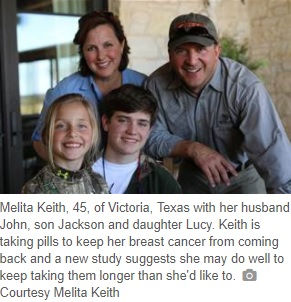
Melita Keith, 45, of Victoria, Texas says she has been putting up with aches and pains after taking first tamoxifen and Aromasin.
"I've been having quite severe joint pains, hot flashes, humorous trigger pinkies. I feel like I'm 90 when I get out of bed. My joints ache," explained Keith. "On tamoxifen, I have hot flashes, night sweats (They were) fairly powerful. On a scale of one to 10, I was 7."
"However, if Dr. Litton tells me I want to be on it, I'm taking it. I need to be there for my kids," said Keith, a patient of Litton's, who wanted to stop the medication and who has a daughter in 6th grade and a son at 12th grade.
Keith and Litton intend to work with each other decide Keith will keep on taking the pills and to watch symptoms through the years.
Doctors have known that breast cancer can come back at a percentage of survivors. University of Michigan Cancer Center has looked at medical records for more than 80,000 women with certain kinds of breast cancer that had been advised to take tamoxifen or similar medications for at least five decades.
"Even after 5 years of endocrine therapy, girls with ER-positive, early-stage breast cancer still had a persistent threat of recurrence and death rate from breast cancer for the last 20 years after the first diagnosis," they wrote in their report, printed in the New England Journal of Medicine.
"Although these women remained free of recurrence in the initial five years, the danger of having their cancer happen elsewhere in their body from years five to 20 remained constant," Hayes said.
These numbers may well not apply to women diagnosed right now with breast cancer the experts mentioned. As treatments are better now and will reduce the risk of cancer coming back.
"I don't need women to hear this study and think they are destined for her cancer to come back," explained Litton.
Winer said breast cancer survivors have to keep a keen eye.


Comments